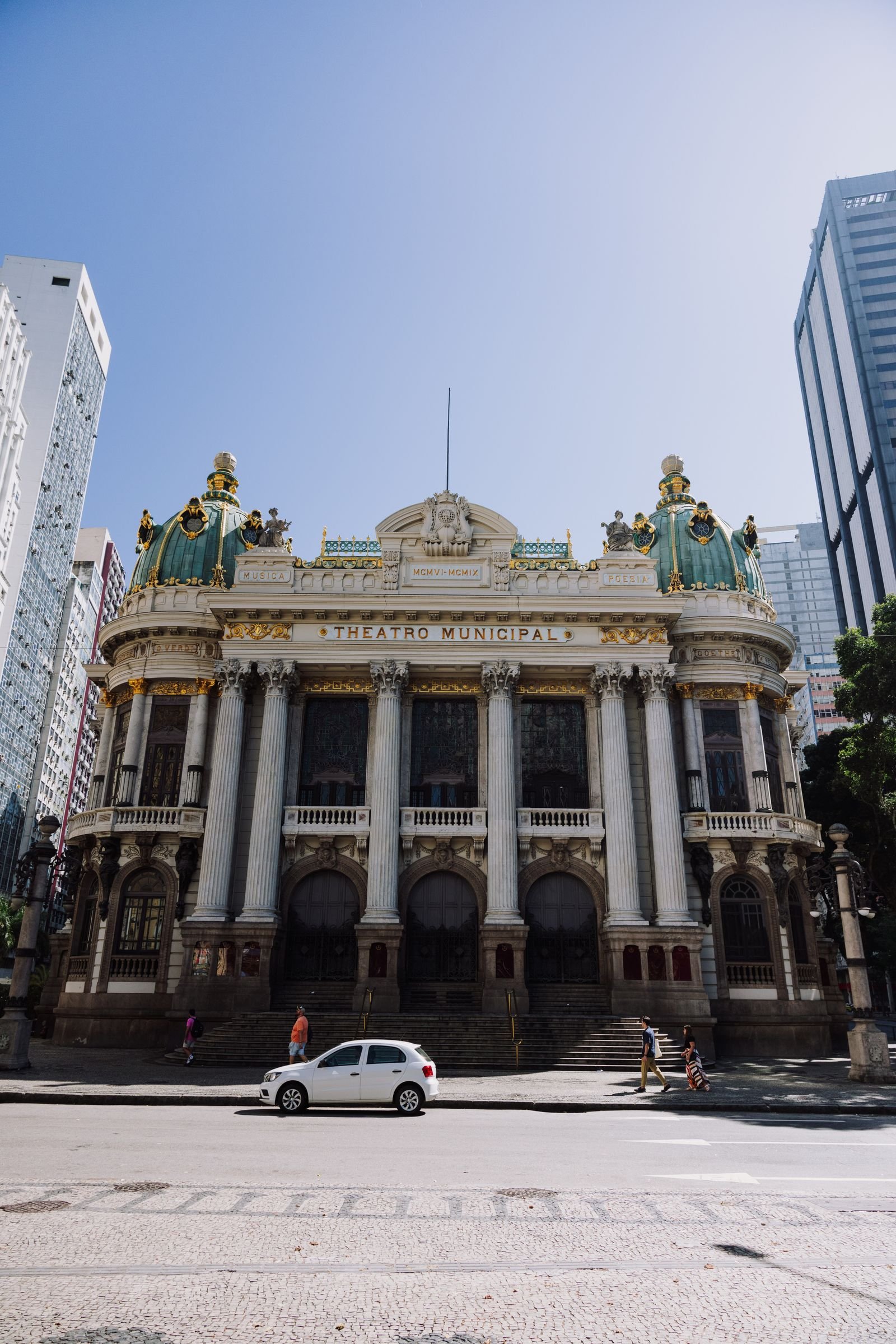
Between century-old buildings, tree-lined squares, and facades that evoke early 20th-century Paris, Rio de Janeiro’s downtown holds one of the city’s richest architectural ensembles—and one of the most overlooked by tourists. The Cinelândia district and its surroundings pack, within just a few blocks, the Theatro Municipal, the National Library, the National Museum of Fine Arts, and the century-old Confeitaria Colombo. In this guide, we’ve put together a complete walking tour of the area, with practical tips on the best days and times to visit safely and comfortably.
Where Cinelândia is and how to get there
Cinelândia is the popular name given to Praça Floriano and its surroundings in downtown Rio. The easiest access is by metro: the Cinelândia station, on lines 1 and 2, drops visitors practically at the door of the Theatro Municipal. The area is also well served by buses and is a short walk from other downtown points, such as Praça Mauá, the Mosteiro de São Bento, and Travessa do Comércio.
Dica: Aproveite também para fazer estes passeios no Rio de Janeiro
Cristo Redentor de trem e tour pelo Rio de janeiro. Duração: 4 horas
Passeio grátis pelo centro histórico do Rio e Lapa. Duração: 3 horas
Free tour pelo bairro de Santa Teresa. Duração: 2h 30m
Amanhecer no mirante de Dona Marta + Cristo Redentor Duração: 4 horas
Veja todos os passeios e tranfers no Rio de Janeiro
Being at the heart of Rio’s administrative and cultural district, Cinelândia has a well-defined rhythm: during the week, especially on business days in the morning and early afternoon, the area is bustling with workers, tourists, and students, with lively bars and kiosks. At night and on weekends, activity drops significantly—something to keep in mind when planning your visit, as we’ll see further on.
Praça Floriano: the heart of Cinelândia
Praça Floriano is the natural starting point for the tour. Flanked by wide promenades, traditional kiosks, and historic buildings, it functions as a kind of “living room” for downtown Rio. It’s also the stage for political demonstrations, cultural events, and, on special dates, big screens and structures set up by the city for open-air shows and screenings.
It’s worth setting aside a few minutes just to take in the surrounding architecture: besides the Theatro Municipal, the square is ringed by eclectic-style buildings from the early 20th century, with decorated facades, mansard roofs, and details that directly reference Parisian architecture—not by chance, this influence is a hallmark of Rio’s urban reform in the 1900s, known as the “Regeneração,” which took the French capital as its model.
A bit of history: the “Regeneração” of downtown Rio
To understand why this part of Rio looks, in certain stretches, like a slice of Paris, you have to go back to the early 20th century. Between 1903 and 1906, Mayor Francisco Pereira Passos pushed through a radical urban reform, popularly known as the “Bota-Abaixo” (Tear-Down): tenements and narrow, unsanitary streets in the center were demolished to make way for wide avenues, eclectic buildings, and tree-lined squares, directly inspired by the renovations Baron Haussmann had carried out in Paris decades earlier.
Avenida Central—today’s Avenida Rio Branco—was the symbol of this transformation, linking the port docks to the area where Cinelândia now stands. The Theatro Municipal, the National Library, and the building that now houses the National Museum of Fine Arts were all built during this period, as part of a project that aimed to turn Rio into the “Paris of the tropics” and prepare it to be the international showcase of republican Brazil. Walking through Cinelândia today is, in large part, walking through that urban project from over a hundred years ago—still visible in the scale of the buildings, the width of the avenues, and the layout of the squares.
Theatro Municipal: Rio’s most luxurious theater
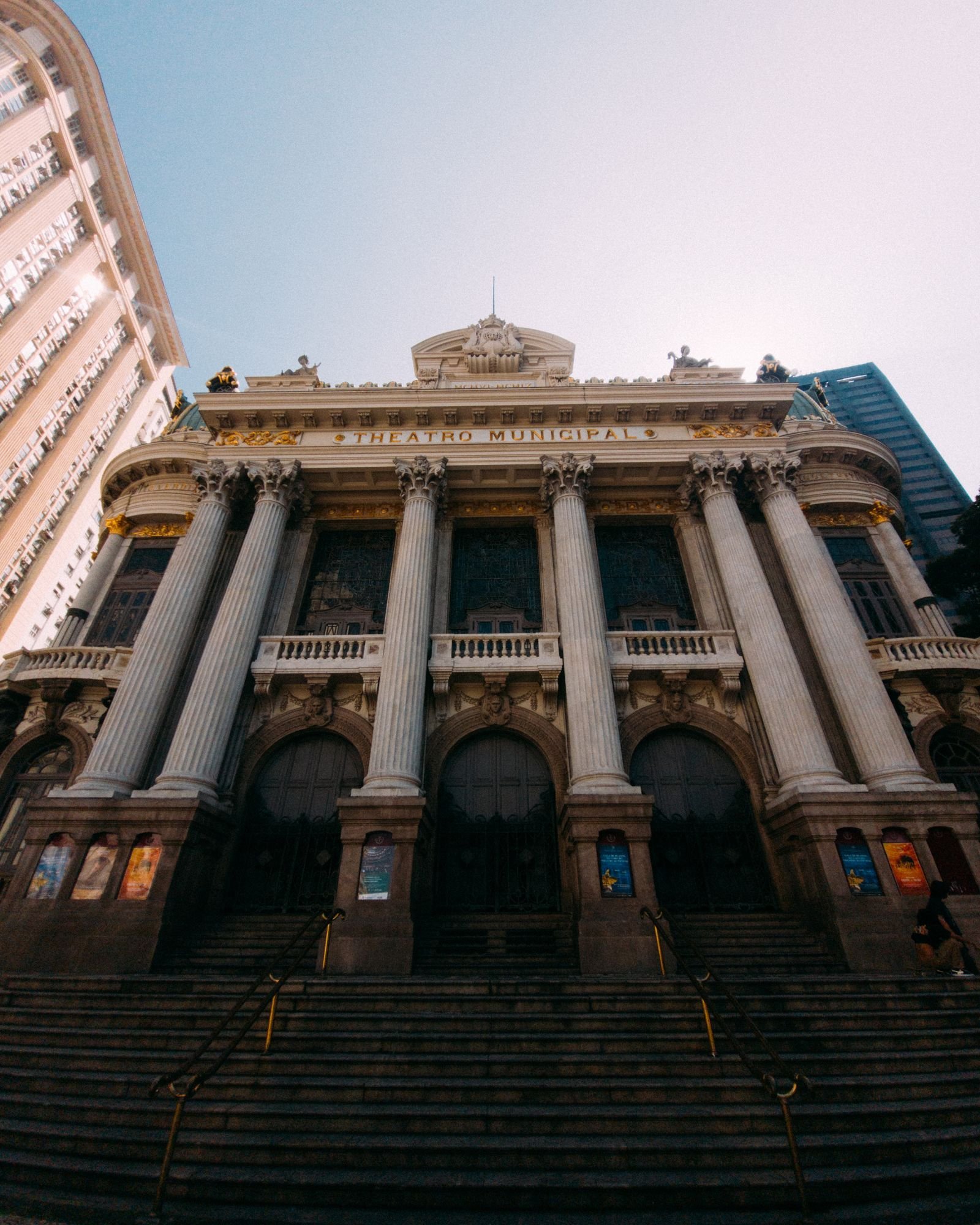
Inaugurated in 1909 and inspired by the Paris Opera (Palais Garnier), the Theatro Municipal do Rio de Janeiro is one of the city’s most sumptuous buildings. Its facade combines marble, columns, and sculptures, while the interior features frescoes, stained glass, chandeliers, and a grand hall decorated in art nouveau style.
The theater is still active today, hosting opera seasons, ballet, and symphony orchestra concerts. For those not attending a performance, guided tours are available that go behind the scenes, through the auditorium, dressing rooms, and even the “Assyrian Room,” a tea salon in the basement decorated with Assyrian and Egyptian motifs—one of the building’s lesser-known curiosities. It’s worth checking the days and times of these guided tours in advance, as they don’t run every day.
National Library: a collection of millions of items
Just steps from the Theatro Municipal, on Avenida Rio Branco, stands the National Library of Brazil—one of the largest libraries in Latin America, with a collection of millions of books, manuscripts, maps, sheet music, and photographs, part of it inherited from the collection that came from Portugal with the royal family in the early 19th century.
The building, inaugurated in 1910, impresses with its neoclassical facade with art nouveau touches, and the main reading hall—with its glass dome and shelves rising to the ceiling—is one of the most beautiful and least visited spaces in downtown Rio. Visitor entry is usually free, but a photo ID is required at the entrance, and some areas require prior registration to consult the collection.
National Museum of Fine Arts (MNBA)
On the other side of Avenida Rio Branco, the National Museum of Fine Arts (MNBA) houses one of the most important collections of Brazilian art, with works ranging from the colonial period to modernism, including the French Artistic Mission of the 19th century—which, in fact, was responsible for much of the academic training that shaped architecture and painting in imperial Brazil.
Highlights of the collection include works by painters such as Pedro Américo, Victor Meirelles, and Tarsila do Amaral, plus an international art gallery with European pieces. The building, with its imposing facade and marble staircase, also hosts major temporary exhibitions throughout the year, which can be an extra reason to fit the visit into your itinerary.
Confeitaria Colombo: the must-do pit stop
To end the tour on a high note (and with a coffee), nothing beats Confeitaria Colombo, just a few minutes’ walk from Cinelândia on Rua Gonçalves Dias. Open since 1894, the confectionery preserves a sumptuous decor, with Belgian mirrors, jacaranda wood furniture, and marble display cases—a practically intact setting from Rio’s Belle Époque.
The menu includes classic sweets like the famous pastel de Santa Rita, as well as savory snacks, teas, and the traditional afternoon tea, served at specific times. It’s a great spot to rest your legs after a walking tour of the historic center, especially on busier days, when it’s worth booking ahead for the afternoon tea.
Suggested walking route
A good sequence for the tour is: start at Cinelândia metro station, cross Praça Floriano while admiring the Theatro Municipal’s facade, head down Avenida Rio Branco to the National Library, cross the avenue to the National Museum of Fine Arts, and finally walk to Confeitaria Colombo for the final stop. This route can be done at a leisurely pace in about three to four hours, including time inside the museums—but it can easily be extended by combining it with other nearby spots, like Travessa do Comércio and the Mosteiro de São Bento.
Extending the route: Travessa do Comércio and Praça XV
Those with more time and energy can extend the outing toward the waterfront, walking about 15 to 20 minutes from Confeitaria Colombo to Praça Quinze de Novembro and Travessa do Comércio. This little cobblestone street, lined with colonial mansions and colorful Portuguese-style buildings, now houses bars and restaurants that get quite lively in the late afternoon and early evening, especially on Fridays, when downtown workers gather for happy hour.
At Praça XV, it’s worth checking out the Paço Imperial, the former residence of the governors-general and later of the Portuguese royal family, now a cultural center with free temporary exhibitions. From there, you can continue on foot to the Mosteiro de São Bento, one of Brazil’s richest ensembles of baroque woodcarving, hidden atop a hill just steps from the downtown bustle—a contrast that sums up the charm of this part of the city: step off the main street and you’ll find an oasis of silence in the middle of the historic center.
Safety tips and best days/times
Rio’s downtown is generally safe during the day on weekdays, when there’s heavy foot traffic, open shops, and a strong presence of workers. The recommendation is to focus your visit during business hours, preferably between Tuesday and Friday, when the museums, the National Library, and the Municipal Theater are operating normally.
On weekends — especially Sundays — and at night, foot traffic drops significantly, many establishments close (some museums don’t open on Mondays, for example), and the area gets emptier, which calls for extra caution. That’s why the general advice is to avoid visiting the historic center outside business hours and, whenever possible, go in a group or book a guided tour, which usually includes detailed historical explanations about the buildings.
It’s also worth checking the opening hours of each attraction in advance — the Municipal Theater, the National Library, MNBA, and Confeitaria Colombo have their own hours and closing days, which can vary depending on special exhibitions or events.
Tickets and approximate costs
In general, the National Museum of Fine Arts and the National Library charge symbolic admission fees (a few reais), with free entry on certain days of the week — it’s worth confirming the updated schedule before you go, since these policies change frequently. The Municipal Theater doesn’t charge to admire the lobby and facade, but guided backstage tours and performances have separate tickets, with prices that vary quite a bit depending on the show and the section you choose.
Confeitaria Colombo, on the other hand, works like any café or restaurant: there’s no admission fee, but afternoon tea has a fixed price per person and usually requires a reservation, especially on weekends and holidays. A good budget for the full itinerary — including museum tickets and a stop at Colombo — falls in a very accessible range by Rio’s cultural attraction standards, making this one of the best value-for-money experiences in the city.
Is the historic center worth adding to your itinerary?
Yes — and it might just be one of the most underrated experiences in Rio de Janeiro. Within a few blocks, you can see up close the architecture that shaped the city’s identity in the early 20th century, visit two of the country’s most important museums, and cap it off with a pause at one of Brazil’s most beautiful historic cafés. For anyone looking for a Rio beyond the beaches and Christ the Redeemer, the historic center — with Cinelândia as the starting point — is an unmissable stop, preferably on a weekday, in the morning or early afternoon.